Speak for the People case study
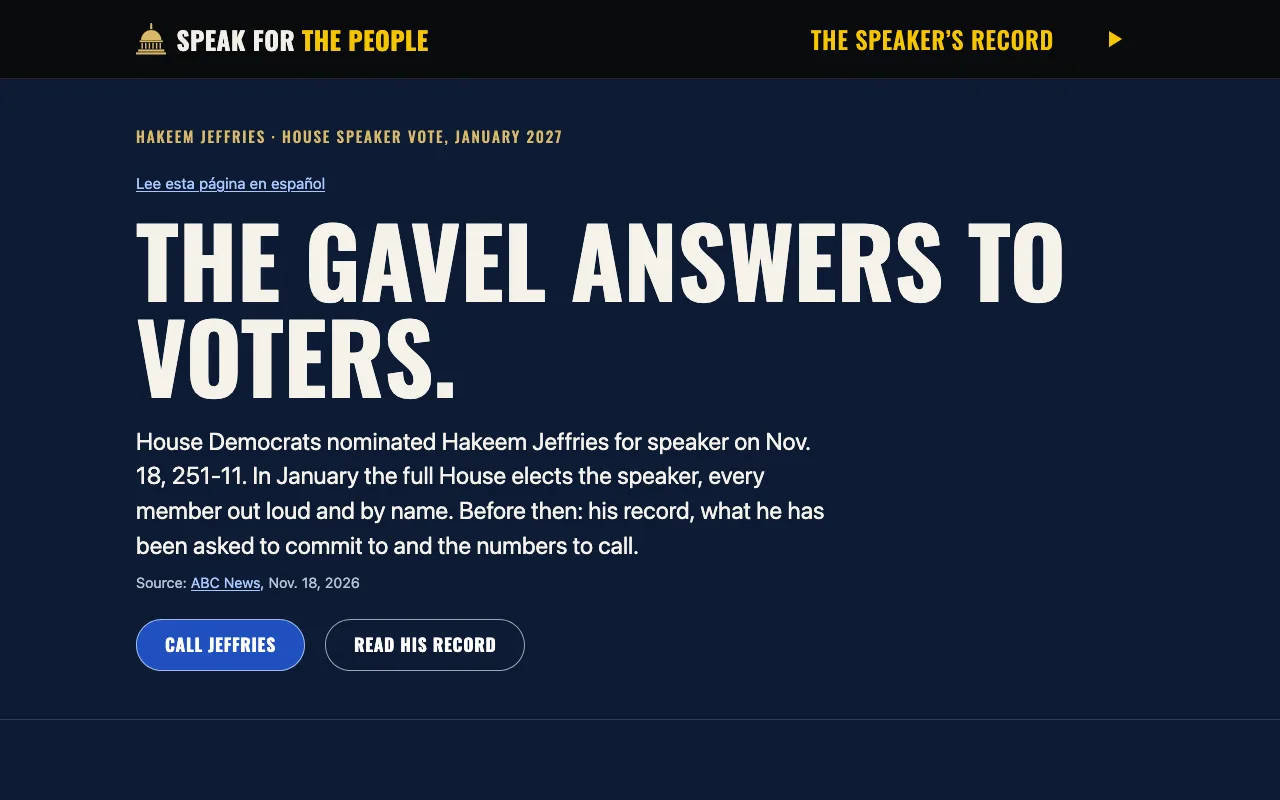
holding the next speaker accountable · House speaker vote, January 2027
visit live siteoverview
An independent site that holds the next House speaker and the rest of Congress accountable to the voters who elect them. House Democrats nominated Hakeem Jeffries 251-11 on Nov. 18, 2026, and the site was rebuilt that day around one idea: the gavel answers to voters.
The home page puts his three offices, his contact forms and a find-my-representative lookup within one tap. A second page carries his record: the 2026 votes where he broke from most House Democrats, the commitments he has been asked to make and his answer so far, and the Democrats on record voting no. Every claim links to its source, and the whole site also runs in Spanish.
site preview
key features
a record with rules
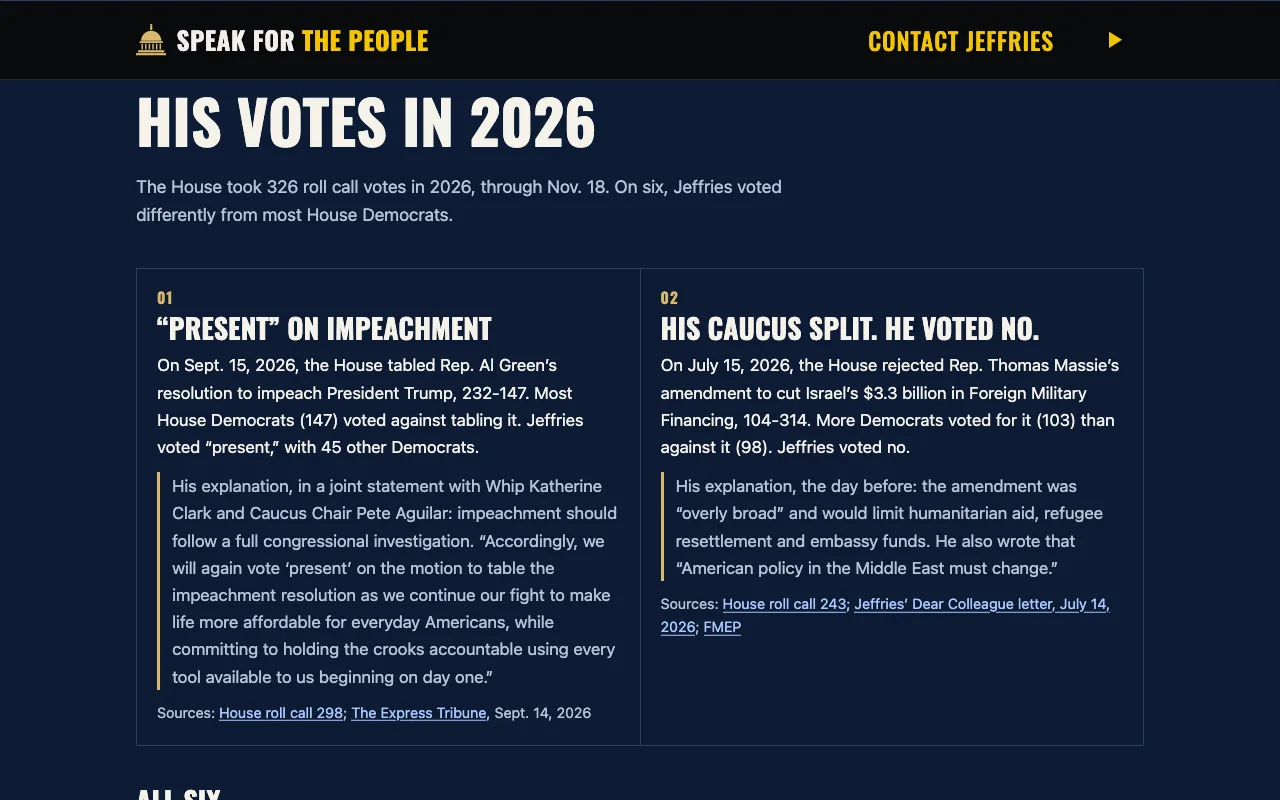
“His votes in 2026” follows a stated rule rather than a selection: every roll call this year where Jeffries voted differently from most House Democrats. A script reads the clerk’s XML for every vote, re-applies the rule and fails if the page is missing one or its counts go stale. Through Nov. 18, that was six of 326.
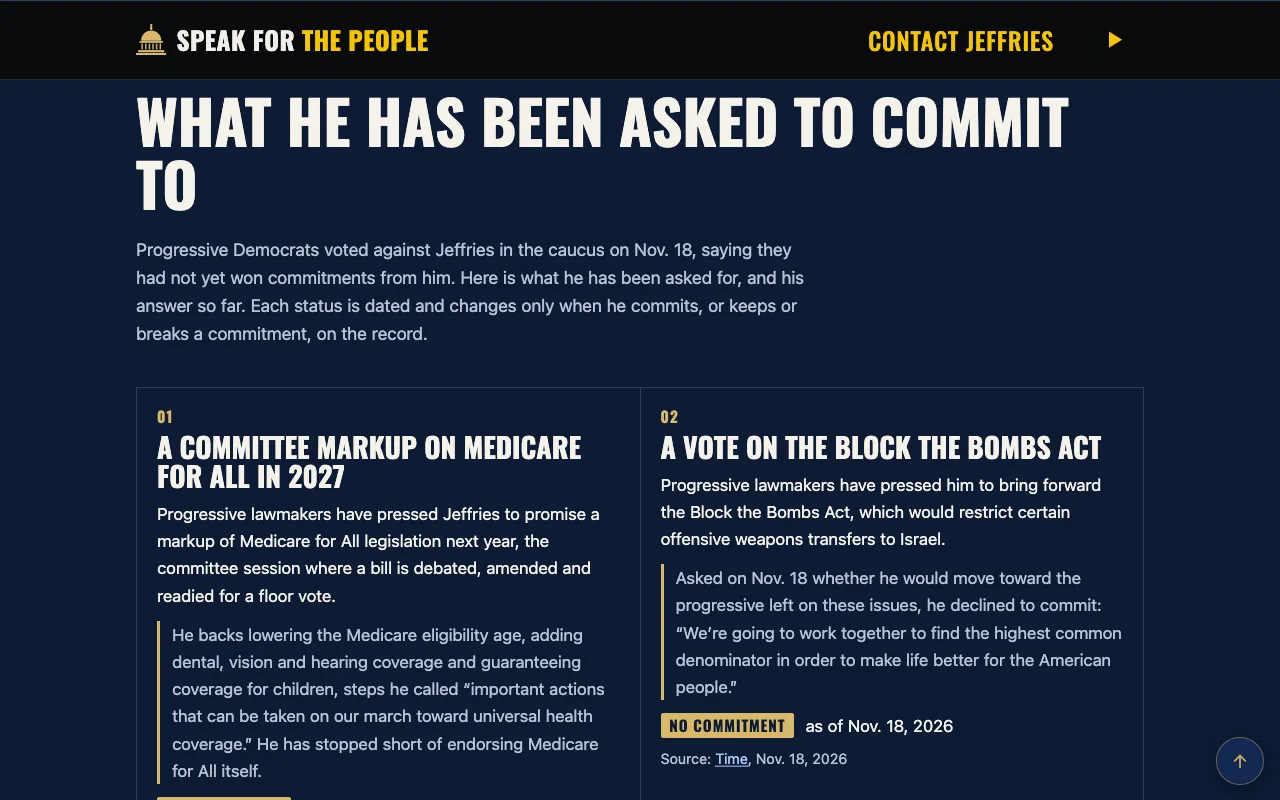
Each vote carries his own explanation, quoted from his statements. The commitments tracker works the same way: a status changes only on a sourced commitment, or a sourced sign he kept or broke one, and every status carries its date. The list of Democrats voting no names only members who said so themselves or were named by ABC News and Time, and where those two outlets disagree, the page says so.
call, don’t just read
Every House member votes for speaker out loud and by name, so the site turns reading into a call. Find my representative asks for a location once, gets the congressional district from the Census Bureau’s geocoder and shows the member, a call button, a short script and how that member voted in the last speaker election, linked to the roll call.
The member list and the speaker votes rebuild hourly from public data, so the lookup moves to the new Congress and the new speaker vote on its own in January, with no date coded anywhere. Delegates, Jeffries’ own district and members sworn in after the last vote each get their own wording.
design decisions
House navy, Capitol gold and Democratic blue, with headlines in Oswald, self-hosted. The header carries the slogan, “Speak for the People,” beside a Capitol dome redrawn on a 32-unit grid so it stays crisp in a browser tab.
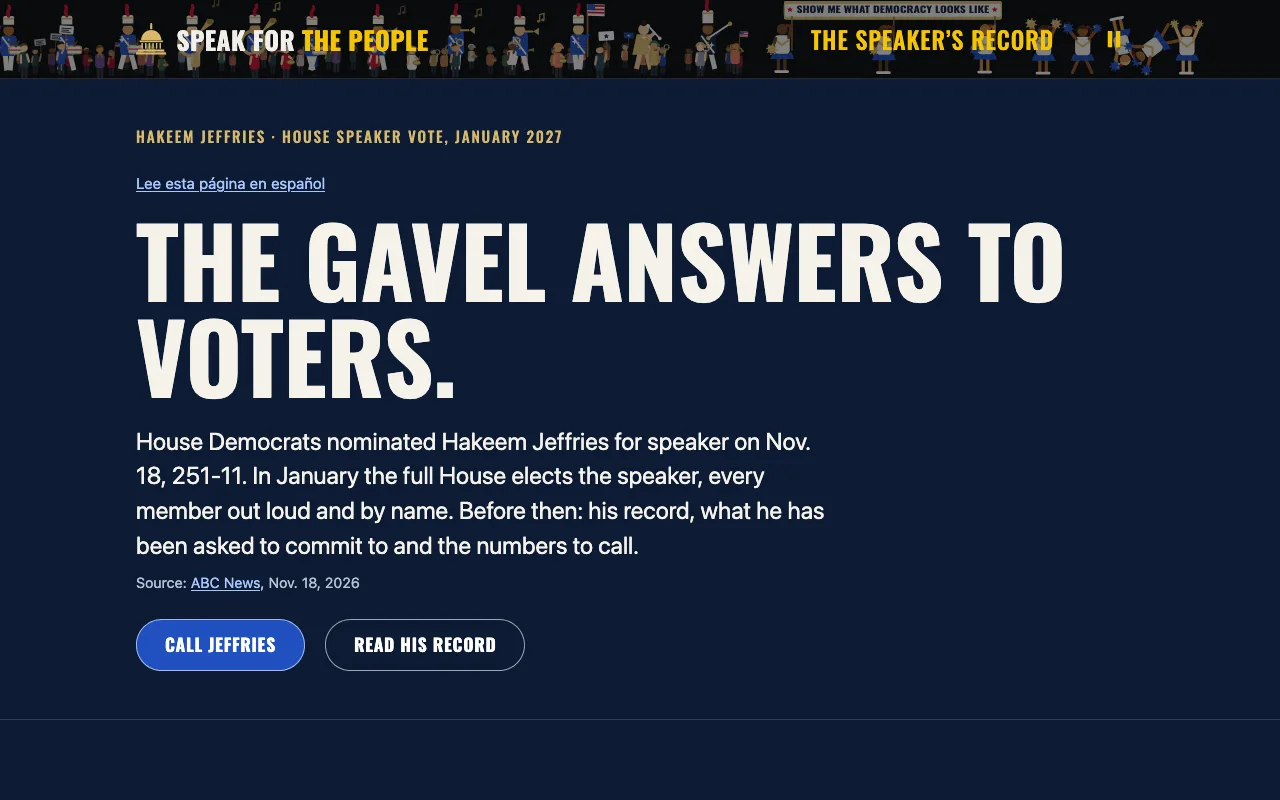
Behind the header, a hand-built SVG parade crosses once per visit: a marching band, Uncle Sam, a marcher in a flag cape and a crowd carrying “Show me what democracy looks like.” It runs at an easy 96 beats per minute, every figure on its own clock. It builds at parade time, so it never weighs on the first screen, and a Play/Pause button and the reduced-motion setting both hold it still.
timeline
- Nov. 7, 2026: launched at projectspeaker.org, split off Kansas Deserves Better, with a Spanish edition, an FAQ on the speaker vote and the parade.
- Nov. 14: find my representative and call tracking.
- Nov. 18: rebuilt after the caucus vote: a contact page, a record page led by the 2026 votes, the commitments tracker, a new logo and the slogan.
- next: the speaker vote, expected Jan. 3, 2027, and the lookup’s switch to the new Congress.